To phir kyun dil udas hai ..?

Hai pyaar bhi tere liye, Khayaal bhi tere liye

Yeh dil bhi tere paas hai, To phir kyun dil udaas hai ..?

Main sochta hun bas tujhe, Main dekhta hun bas tujhe

Jab mujh pe aitbaar hai, To phir kyun dil udaas hai ..?

Hai zindagi tere liye, Yeh dil, khushi tere liye

Yeh sab jo tere paas hai, To phir kyun dil udaas hai ..?

Tu neend mein, tu khwab mein, Tu mere dasht-o-aab mein

Har pal tu mere saath hai, To phir kyun dil udaas hai ..?

Har gulshan hain gul khile huye, Hain dost bhi mile huye

Har lamha pyaar hi pyaar hai, To phir kyun dil udaas hai ..?

Yeh dil, khushi or aitbaar, Yeh dost, khwab or yeh pyaar

Sab kuch tu tere pass hai, To phir kyun dil udaas hai ..?

Keep Smiling my Friend

- - Kalingaa…

It is never too late to learn and love

The art of losing isn't hard to master; so many things seem filled with the intent to be lost that their loss is no disaster.

Lose something every day. Accept the fluster of lost door keys, the hour badly spent. The art of losing isn't hard to master. I lost numerous cities, lovely ones. And, vaster, some realms I owned, two rivers, a continent. I miss them, but it wasn't a disaster.

Even losing you... the joking voice, a gesture I love... I shan't have lied. It's evident the art of losing's not too hard to master though' it may look like...

Write it!... like disaster

-- Kalingaa...

The Silence of Love

Hello darkness, my old friend,

I've come to talk with you again,

Because a vision softly creeping,

Left its seeds while I was sleeping,

And the vision that was planted in my brain

Still remains Within the sound of silence…


In restless dreams I walked alone

Narrow streets of cobblestone,

Underneath the halo of a street lamp,

I turned my collar to the cold and damp

When my eyes were stabbed by the flash of a Neon light

That split the night and touched the Sound of silence…


And in the naked light I saw

Ten thousand people, maybe more.

People talking without speaking,

People hearing without listening,

People writing songs that voices never share

And no one dare disturb the sound of silence…


Fools said i, you do not know

Silence like a cancer grows.

Hear my words that I might teach you,

Take my arms that I might reach you.

But my words like silent raindrops fell,

And echoed in the wells of silence…


And the people bowed and prayed

To the neon God they made.

And the sign flashed out its warning,

In the words that it was forming.

And the sign said, the words of the prophets…

Are written on the subway walls

And tenement halls.

And whispered in the sounds of silence…

Keep smiling
Kalingaa...

Happy Republic Day to India

This is a poem to all of you:
Tum Chalo to Hindustan chale
Phalak pakad ke utho
Aur hawa pakad ke chalo
Tum chalo to Hindustan chale

Lagao hath ki suraj subah nikala karein
Hathelion mein bharein dhoop aur uchhala karein
Uphak pe paon rakho

Aur chalo akad ke chalo
Phalak pakad ke utho...
aur hawa pakad ke chalo!
Tum chalo to Hindustan chale
-- India awaits you
- - Kalingaa...

Spirit of Untiring Courage

तूफानों की ओर घुमा दो नाविक निज पतवार ।

आज सिन्धु ने विष उगला है
लहरों का यौवन मचला है
आज ह्रदय में और सिन्धु में
साथ उठा है ज्वार

तूफानों की ओर घुमा दो नाविक निज पतवार ।

लहरों के स्वर में कुछ बोलो
इस अंधड में साहस तोलो
कभी-कभी मिलता जीवन में
तूफानों का प्यार

तूफानों की ओर घुमा दो नाविक निज पतवार ।

यह असीम, निज सीमा जाने
सागर भी तो यह पहचाने
मिट्टी के पुतले मानव ने
कभी ना मानी हार
तूफानों की ओर घुमा दो नाविक निज पतवार ।

सागर की अपनी क्षमता है
पर माँझी भी कब थकता है
जब तक साँसों में स्पन्दन है
उसका हाथ नहीं रुकता है
इसके ही बल पर कर डाले

सातों सागर पार
तूफानों की ओर घुमा दो नाविक निज पतवार ।

- शिवमंगल सिंह सुमन

-- Keep the spirit of courage against mightiest
- - Kalingaa...

Yeh Hum Nahin

किसी के इतने पास न जा
कि दूर जाना खौफ़ बन जाये
एक कदम पीछे देखने पर
सीधा रास्ता भी खाई नज़र आये

किसी को इतना अपना न बना
कि उसे खोने का डर लगा रहे
इसी डर के बीच एक दिन ऐसा न आये
तु पल पल खुद को ही खोने लगे

किसी के इतने सपने न देख
कि काली रात भी रन्गीली लगे
आन्ख खुले तो बर्दाश्त न हो
जब सपना टूट टूट कर बिखरने लगे

किसी को इतना प्यार न कर
कि बैठे बैठे आन्ख नम हो जाये
उसे गर मिले एक दर्द
इधर जिन्दगी के दो पल कम हो जाये

किसी के बारे मे इतना न सोच
कि सोच का मतलब ही वो बन जाये
भीड के बीच भी
लगे तन्हाई से जकडे गये

किसी को इतना याद न कर
कि जहा देखो वोही नज़र आये
राह देख देख कर कही ऐसा न हो
जिन्दगी पीछे छूट जाये

ऐसा सोच कर अकेले न रहना,
किसी के पास जाने से न डरना
न सोच अकेलेपन मे कोई गम नही,
खुद की परछाई देख बोलोगे "ये हम नही"

-- Keep the faith in Dreams
- - Kalingaa...

Dil Tod Ke Na Naa... Mukh Mod Ke Na Jaa...

Just randon thought about one of my favourite songs sang by Kishore Da -
Pal bhar ke liye koi humme pyaar kar le
Jhoota hi sahi
Do din ke liye koi ikraar kar le
Jhoota hi sahi
Pal bhar ...

Humne bahut tujhko chup chupke dekha
Dil pe khichi hai tere kaajal ki rekha
Kaajal ke rekha bani laxman ki rekha
Ho Ho Ho Ho kaajal ki rekha ...
Ram mein kyun tune rawan ko dekha
khade khidki pe ...
Khade khidki pe jogi sweekar kar le
Jhoota hi sahi
Pal bhar ...

La La La ... pyaar kar le

Jhoota hi sahi
Dheere se jade tere nain bade,
Jis din se lade tere dar pe pade
Dheere se jade tere nain bade,
Jis din se lade tere dar pe pade

Sun Sunkar teri nahi nahi
Jaan ... Apni nikal jaye naa kahi
Jara haan kah de meri jaan kah de
Meri jaan kah de jara haan kah de
Jab raain pade nahi chain pade
nahi chain pade jab raain pade

Mana tu saare haseeno se haseen hain
Apni bhi soorat buri tho nahi hai

Kabhi tu bhi
O kabhi tu bhi humara deedar kar le
Jhoota hi sahi
Pal Bhar Ke Liye Koi hume Pyaar Kar Le ...
-- Keep the Heart open. Love Just Happens ...
- - Kalingaa...

Rabba main itna bura nahin hota

Evils of Success...

After getting information about conviction of Sanjay Dutt in Arms Act, once again I was stunned that Fame comes with a lot of tension and pity in Life. Rarely a person can survive ills and pitfalls of celebrity life. Life where you don’t have privacy, every single step is being watched by millions and no space for individual. Everyone wants to attain that fame, and glitterati with a lot of hard cash and assets, but everytime we achieve it, we unintentionally fall for its innovative wrong-ones and the moment we realize about it, we are a long way down the road. Turning back seems like trying to reach to Mt. Everest and eventually we see shame for us in eyes of our beloved ones.


I may not have been well-known person but I have seen few such moments where I was on opposite side of social norms and I can understand what emotional stress a person goes through in such situation.

"Be not afraid of greatness: some men are born great, some achieve greatness and some have greatness thrust upon them."
- William Shakespeare

"I don't know the key to success, but the key to failure is trying to please everybody."
- Bill Cosby

Yes, Sanjay Dutt did something which was against Unity of India and if his crime is big enough than hang him for his crime, But also we should look for reasons that why a person of such caliber and status do a crime against society? Kill the evils of society and criminals will be dead automatically.

Socha nahin tha taqdeer yahan layegi

Manzil pe aate hi jaan chali jayegi
O, yeh to Sikandar ne bhi nahin tha socha
Aane se pehle khushi laut jayegi
Humne socha tha kya, aur kya se kya hua
Jaa rahe hai aaj yeh zamane ko batake

Yeh kya ho gaya rama re, yeh kya ho gaya maula re

Tera kusoor tha ya mera kusoor tha
Tera guroor tha ya mera guroor tha
Rabba main itna bura nahin hota
Tu agar bewafa nahin hota
Itna bata mujhe, kya mila tujhe
Gham ke yeh kaante meri raahon mein bichhaake

Yeh kya ho gaya rama re, yeh kya ho gaya maula re

-- Keep the Society alive by killing Crime
- - Kalingaa…

P.S. – On the side note, Bring Dada in Indian Cricket team for revival of Titans

All I can do

An old man lived alone in Minnesota. He wanted to spade his potato garden, but it was very hard work. His only son, who would have helped him, was in prison. The old man wrote a letter to his son and mentioned his situation:

Dear Son,
I am feeling pretty bad because it looks like I won't be able to plant my potato garden this year. I hate to miss doing the garden, because your mother always loved planting time. I'm just getting too old to be digging up a garden plot. If you were here, all my troubles would be over. I know you would dig the plot for me, if you weren't in prison.
Love,
Dad

Shortly, the old man received this telegram:

For Heaven's sake, Dad, don't dig up the garden!! That's where I buried the GUNS!!

At 4a.m the next morning, a dozen police officers showed up and dug up the entire garden without finding any guns. Confused, the old man wrote another note to his son telling him what happened, and asked him what to do next.

His son's reply was: "Go ahead and plant your potatoes, Dad. It's the best I could do for you from here."
-- Keep doing whatever you can do for all your loved ones
- - Kalingaa...

Complex nature of English

Can you decipher this:

Two individuals proceeded towards the apex of a natural geologic protuberance, the purpose of their expedition being the procurement of a sample of fluid hydride of oxygen in a large vessel, the exact size of which was unspecified. One member of the team precipitously descended, sustaining severe damage to the upper cranial portion of his anatomical structure; subsequently the second member of the team performed a self rotational translation oriented in the same direction taken by the first team member

..
..
..
..
..
..
..
..
..
..
..
..
..
(in simple English what does this translate to??)
..
..
..
..
..
..

..
..
..
..
..
..
..
..
..
..
..
..
..
..
..
..
..
..
..
..
Jack and jill went up the hill to fetch a pail of water Jack fell down and broke his crown and jill came.

-- Keep complex nature away and be simple
- - Kalingaa..

Close All Schools

Following is an Article in Times of India written by Sauvik Chakraverti.
Individuals require less knowledge in order to survive in today’s complex world than they did in the far simpler past. Village life requires knowing how to grow your food, look after and milk your cows and build your own house. In a modern city, one can easily get by just knowing how to play the guitar well. A musician in the urban ‘division of labour’ can then happily rely on the specialised knowledge of others. His car is built by engineers, kept in good repair by mechanics and driven by a skilled chauffeur. His house is built by an architect and aesthetically furnished by an interior decorator. Farmers grow his food and this is cooked by a trained chef. In all these (and all other) areas, our musician is blissfully ignorant. Economists call this phenomenon ‘rational ignorance’: It shows how, as the economy diversifies, less real knowledge is required on the part of each participant. This has enormous implications on the sort of education system required in a modern ‘knowledge economy’.

The existing school system provides generalised knowledge of dubious quality. Even after 12 years of schooling, a student does not possess any knowledge
that could be useful in the market. Further, higher education is required. This generalised, broad education is difficult for students to assimilate: Many commit suicide. The only career open for those with this generalised education is the bureaucracy, who are the proverbial ‘jack of all trades’. This horrible school system should be closed down. All Indian children should be publicly informed that survival in the modern world requires fragmented bits of specialised knowledge, and that the search for such knowledge is simplicity itself. Apart from basic language skills, preferably in English, and knowing how to use a calculator, all that a young person needs is knowledge in one single field. He must, therefore, find a calling, and seek knowledge relevant to that calling alone. He can find this by apprenticeship. He can acquire it from a guru. Or from a specialised school. This will give the aspiring student hope. The search for knowledge will not seem such a long, uphill task as it is today. So close every school down, and let the knowledge economy explode.
-- Keep the knowledge Intact
- - Kalingaa...

"Die Every Day" - J. Krishnamurti

I am reading writings of J. Krishnamurti now-a-days and he is great philosophy writer. Following is a pharase from his book "A Book of Life". I am trying to grasp as much books as possible.

"What is age? Is it the number of years you have lived? That is part of age; you were born in such and such a year, and now you are fifteen, forty or sixty years old. Your body grows old - and so does your mind when it is burdened with all the experiences, miseries and weariness of life; and such a mind can never discover what is truth. The mind can discover only when it is young, fresh, innocent; but innocence is not a matter of age.

It is not only the child that is innocent - he may not be - but the mind that is capable of experiencing without accumulating the residue of experience. The mind must experience, that is inevitable. It must respond to everything - to the river, to the diseased animal, to the dead body being carried away to be burnt, to the poor villagers carrying their burdens along the road, to the tortures and miseries of life - otherwise it is already dead; but it must be capable of responding without being held by the experience.

It is tradition, the accumulation of experience, the ashes of memory, that make the mind old. The mind that dies every day to the memories of yesterday, to all the joys and sorrows of the past - such a mind is fresh, innocent, it has no age; and without that innocence, whether you are ten or sixty, you will not find God."

-- Keep the fear of death away and Njoi your life
- - Kalingaa...

Children and You


Its better to be a stupid child than to be a mean grown up.
Keep your child part alive and smiling because "Bachche Mann Ke Sachche".

Happy Children's Day.

Support CRY (Child Relief and You) at www.cry.org .
Your one step will make difference in someone's life.

-- Keep smiling
- - Kalingaa...

Gitanjali

I don't have to say anything about "Ravindernath Tagore" and his most known work "Gitanjali".

Its a part of this work -
Where the mind is without fear and the head is held high
Where knowledge is free
Where the world has not been broken up into fragments by narrow domestic walls
Where words come out from the depth of truth
Where tireless striving stretches its arms towards perfection
Where the clear stream of reason has not lost its way into the dreary desert of dead habit....
Where the mind is led forward by thee
Into ever-widening thought and action
Into that heaven of freedom, my father, let my country awake.
-- Keep the free spirit of mind
- - Kalingaa..

A Tryst with Destiny of REPUBLIC

After reading speech by Mahasweta Devi, first speech which came in my mind was speech by Mr. Jawaharlal Nehru Delivered on August 14th, 1947. He gave this Speech in the Constituent Assembly of India, on the eve of India's Independence. This speech in important to remember the pledges which our forefather made to this country and we have to re-think why we fell short of our vision.

They had a vision and we as youth have will power so let's take the target of "One India, Only India".

Long years ago we made a tryst with destiny, and now the time comes when we shall redeem our pledge, not wholly or in full measure, but very substantially. At the stroke of the midnight hour, when the world sleeps, India will awake to life and freedom. A moment comes, which comes but rarely in history, when we step out from the old to the new, when an age ends, and when the soul of a nation, long suppressed, finds utterance. It is fitting that at this solemn moment, we take the pledge of dedication to the service of India and her people and to the still larger cause of humanity.

At the dawn of history, India started on her unending quest, and trackless centuries are filled with her striving and grandeur of her success and failures. Through good and ill fortune alike, she has never lost sight of that quest, forgotten the ideals which gave her strength. We end today a period of misfortunes and India discovers herself again. The achievement we celebrate today is but a step, an opening of opportunity to the greater triumphs and achievements that await us. Are we brave enough and wise enough to grasp this opportunity and accept the challenge of the future?

Freedom and power bring responsibility. The responsibility rests upon this Assembly, a sovereign body representing the sovereign people of India. Before the birth of freedom, we have endured all the pains of labour and our hearts are heavy with the memory of this sorrrow. Some of those pains continue even now. Nevertheless, the past is over and it is the future that beckons us now.

That future is not one of ease or resting but of incessant striving so that we may fulfill the pledges we have so often taken and the one we shall take today. The service of India means, the service of the millions who suffer. It means the ending of poverty and ignorance and poverty and disease and inequality of opportunity. The ambition of the greatest men of our generation has been to wipe every tear from every eye. That may be beyond us, but as long as there are tears and suffering, so long our work will not be over.

And so we have to labour and to work, and to work hard, to give reality to our dreams. Those dreams are for India, but they are also for the world, for all the nations and peoples are too closely knit together today for any one of them to imagine that it can live apart. Peace is said to be indivisible, so is freedom, so is prosperity now, and also is disaster in this one world that can no longer be split into isolated fragments.

To the people of India, whose representatives we are, we make an appeal to join us with faith and confidence in this great adventure. This is no time for petty and destructive criticism, no time for ill-will or blaming others. We have to build the noble mansion of free India where all her children may dwell.


The appointed day has come -the day appointed by destiny- and India stands forth again, after long slumber and struggle, awake, vital, free and independent. The past clings on to us still in some measure and we have to do much before we redeem the pledges we have so often taken. Yet the turning-point is past, and history begins anew for us, the history which we shall live and act and others will write about.

It is a fateful moment for us in India, for all Asia and for the world. A new star rises, the star of freedom in the East, a new hope comes into being, a vision long cherished materializes. May the star never set and that hope never be betrayed!

We rejoice in that freedom, even though clouds surround us, and many of our people are sorrow-stricken and difficult problems encompass us. But freedom brings responsibilities and burdens and we have to face them in the spirit of a free and disciplined people.

On this day our first thoughts go to the architect of this freedom, the Father of our Nation, who, embodying the old spirit of India, held aloft the torch of freedom and lighted up the darkness that surrounded us. We have often been unworthy followers of his and have strayed from his message, but not only we but succeeding generations will remember this message and bear the imprint in their hearts of this great son of India, magnificent in his faith and strength and courage and humility. We shall never allow that torch of freedom to be blown out, however high the wind or stormy the tempest.

Our next thoughts must be of the unknown volunteers and soldiers of freedom who, without praise or reward, have served India even unto death.

We think also of our brothers and sisters who have been cut off from us by political boundaries and who unhappily cannot share at present in the freedom that has come. They are of us and will remain of us whatever may happen, and we shall be sharers in their good [or] ill fortune alike.

The future beckons to us. Whither do we go and what shall be our endeavour? To bring freedom and opportunity to the common man, to the peasants and workers of India; to fight and end poverty and ignorance and disease; to build up a prosperous, democratic and progressive nation, and to create social, economic and political institutions which will ensure justice and fullness of life to every man and woman.

We have hard work ahead. There is no resting for any one of us till we redeem our pledge in full, till we make all the people of India what destiny intended them to be. We are citizens of a great country on the verge of bold advance, and we have to live up to that high standard. All of us, to whatever religion we may belong, are equally the children of India with equal rights, privileges and obligations. We cannot encourage communalism or narrow-mindedness, for no nation can be great whose people are narrow in thought or in action.

To the nations and peoples of the world we send greetings and pledge ourselves to cooperate with them in furthering peace, freedom and democracy.

And to India, our much-loved motherland, the ancient, the eternal and the ever-new, we pay our reverent homage and we bind ourselves afresh to her service.

JAI HIND.

- Jawahar Lal Nehru

-- Keep the pledges to your heart
- - Kalingaa..

THE REPUBLIC OF DREAMS

Mahasweta Devi - the Great Old Lady of Indian Lit.
She is one of most prominent authors from Indian sub-continet and I have priviledge of reading many of her writings like Hajar Churashir Ma (No. 1084's Mother), Aranyer Adhikar (The Occupation of the Forest) , Choti Munda evam Tar Tir (Choti Munda and His Arrow) etc.

In her own words, she simply puts her insipiration in -
"I have always believed that the real history is made by ordinary people. I constantly come across the reappearance, in various forms, of folklore, ballads, myths and legends, carried by ordinary people across generations....The reason and inspiration for my writing are those people who are exploited and used, and yet do not accept defeat. For me, the endless source of ingredients for writing is in these amazingly, noble, suffering human beings. Why should I look for my raw material elsewhere, once I have started knowing them? Sometimes it seems to me that my writing is really their doing."
Recently she had people in tears at this year's Frankfurt Book Fair. Delivered with passionate heart, her inaugural speech about our freedom still on hold stirs a kind of moral transformation.


Excerts of Mahasweta Devi's speech in Frankfurt Book Fair 2006-

At 80-plus I move forward often stepping back into the shadows. Sometimes I am bold enough to step back into the sunlight. As a young person, as a mother, I would often move forward to when I was old. Amuse my son. Pretend I couldn’t hear or see. Make mockery of memory, forget things that had happened a moment ago. These games were for fun. Now they are no longer funny. My life has moved forward and is repeating itself. I am repeating myself. Recollecting for you what has been. What is. What could have been. May have been.

See the tree, the forest, the field lush with crops, a stream dazzling in sunlight. And see, the spotted deer are jumping and fleeing to the forest, the mothers are filling the pitchers from the stream, clutching their children. And the houses are the ones they left behind at Badihatta. The sun is leaning to see the earth. The peasants are irrigating their fields. What an expanse of forest. How green the hills are.

Nothing happens unless you know how to dream. The Establishment is out to destroy, by remote control, all the brain cells that induce dreams. But some dreams manage to escape. I am after the dreams that have escaped from jail. The right to dream is what allows mankind to survive. If you end the right to dream — which the entire world and everyone is doing — you destroy the world. The right to dream should be the first fundamental right. The right to dream. [...]

There’s a story about Nanak — his father made him sit in a shop, told him to sell goods… dus, gyarah, barah, tera… tera, tera, tera... and he gave everything away. Everything is yours. With me, everything became tera… nothing touches the inside. Material things don’t touch me, I remain an outsider, I can’t always be an insider. Genuine warmth, real understanding, some friendship, a few strange things touch me, but I’m an outsider and an insider at the same time. [...]

Since the 1980s, I have been vocal about the daily injustice and exploitation faced by the most marginalised and dispossessed of our people: tribals, the landless rural poor who then turn into itinerant labour or pavement dwellers in cities. Through reports in newspapers, through petitions, court cases, letters to the authorities, participation in activist organisations and advocacy, through the grassroots journal I edit, Bortika, in which the dispossessed tell their own truths, and finally through my fiction, I have sought to bring the harsh reality of this ignored segment of India’s population to the notice of the nation, I have sought to include their forgotten and invisible history in the official history of the nation. I have said over and over, our Independence was false; there has been no Independence for these dispossessed peoples, still deprived of their most basic rights.

How to save and protect one’s culture in these circumstances? Which culture do we protect? And what do we mean when we speak of Indian culture in the 21st century? What culture? Which India? Sixty years after our hard-won Independence, the khadi sari is India just as the mini skirt and the backless choli is. A bullock cart is India just as much as is the latest Toyota or Mercedes car. Illiteracy haunts us, yet the same India produces men and women at the forefront of medicine, science and technology. Eight-year-old children toil mercilessly, facing unimaginable working conditions and abuse as child labourers. That is India. On the other hand, there is another lot of eight-year-olds who spend their time in air-conditioned classrooms and call their mothers at lunch break using their personal mobile phones. That too is India. Satyam Shivam Sundaram is India. Choli ke peechchey kya hai is also India. The multiplex and the mega mall are India. The snake charmer and the maharishi — they too are India.

Indian culture is a tapestry of many weaves, many threads. The weaving is endless as are the shades of the pattern. Somewhere dark, somewhere light, somewhere saffron, somewhere as green as the fields of new paddy, somewhere flecked with blood, somewhere washed cool by the waters of a Himalayan spring. Somewhere the red of a watermelon slice. Somewhere the blue of an autumn sky in Bengal. Somewhere the purple of a musk deer’s eye. Somewhere the red of a new bride’s sindoor. Somewhere the threads form words in Urdu, somewhere in Bengali, somewhere in Kannada, somewhere in Assamese, yet elsewhere in Marathi. Somewhere the cloth frays. Somewhere the threads tear. But still it holds. Still. It holds.

The pattern shifts, flows, stutters, forms again and changes shape from one season to the other. I see one India in the pattern. You see another. Light and shadow play. History and modernity collide. Superstition and myth, Rabindrasangeet and rap, Sufi and Shia and Sunni, caste and computers, text and sub-plot, laughter and tears, governments and oppositions, reservations and quotas, struggles and captivity, success and achievement, hamburgers and Hari Om Hari, Sanskrit and sms, the smell of rain and the sound of the sea. A seamless stitching. Many, many hands have stitched, are stitching and will continue to stitch India. My country. Torn, tattered, proud, beautiful, hot, humid, cold, sandy, bright, dull, educated, barbaric, savage, shining India. My country. And its myriad cultures. From time immemorial to now, the 21st country. From the Indus Valley to the bluetooth handset, India has seen it all, contains it all within itself and its cultures. There is room in India for all faiths, all languages, all people. Despite the communal crises, despite the fundamentalism, the backwardness of rural life, the memories of underdevelopment which are no memory but reality for us, the threat of aids, tsunamis, earthquakes, floods and droughts, farmer suicides, police violence, environmental disasters wreaked by industries and farmland being bought over by multinational companies, despite the battering by history and circumstance, India still is. Its culture still is. Hence we all still are. India has learnt to survive, to adapt, to keep the old with the modern, to walk hand in hand with the new millennium whistling a tune from the dawn of time. This is truly the age when the joota is Japani, the patloon Englistani, the topi Roosi. But the dil — the dil is and always will remain Hindustani.

As we face the future, and as I stand here, invited to speak of my country’s culture before such an eminent gathering and at such an honourable occasion, I wish to share my dream of where I would like to see my India go. I have spoken of the fundamental right to dream. I would now like to exercise that right.

I dream of an India where the mind is without fear and the head is held high. Where knowledge is free. Where the world has not been broken into fragments by narrow domestic walls. Where words come out of the depth of truth. Where tireless striving stretches its arms towards perfection. Where the clear stream of reason has not lost its way in the dreary sand of dead habit.

I dream of an India to which the world ‘backward’ does not and cannot ever apply. I wish to be Third World no more but First, the only world. I wish for children to be educated. I wish for women to step into the light. I wish for justice for the common man. Survival for the farmer. Homes for the poor. And hope for all. I wish for debts to cease. For poverty to vanish. For hunger to become a bad word that no one utters. I wish for the environment to be protected, to be loved and restored. I wish the land to be healed, the waters to be pure again. For the tiger to survive. I wish for self reliance, for self respect, for independence from the shackles of superstition. I wish for equal medical aid for all.

For light and water and a roof above every head. I wish for more and more books to be written, to be published, in every language there is in the country. Let the words pour out. Let the stories be told. Let the people read. Let them learn to read. To trace their fingers over every alphabet until they can spell their names. Their addresses. Until they can write for themselves: I know. I can. I will. Let us fight ignorance with knowledge. Let us battle hatred with logic. Let us slay evil with the sword of the pen.

I wish for no more satis, no more dowry deaths, no more honour killings, no more flesh being bought and sold. Let no more parents sell their children to survive. Let no more mothers drown their daughters in the dead of night. Let the downtrodden awake, let the forgotten faces and the muffled voices arise to claim their own. Let the pattern make room, let these new threads find place, let new colours set afire the tapestry. Set ablaze the future. Into that heaven of freedom, let my India awaken again and again. It is a big dream, I know. But not an impossible one.

When I speak of Indian culture, then, I speak of all this. Culture is what will take us into the future yet keep us in close contact with our roots, our history, our tradition, our heritage. Culture will let us take a quantum leap and land on the moon bur first, before all that, it must help us take a few small steps towards understanding ourselves better, towards knowing each other better. Culture must once again remind us to be a tolerant and truly secular people.

I have tried in my own way to give you a picture of this culture. But how am I to even to begin arriving at a definition that will be acceptable to all across an India that is so chaotic. So calm. So flexible. So rigid. So rich. So poor. So understanding. So easy to be misunderstood. After all, there are many Indias, as I say over and over again. Simultaneous. Even parallel.

And whose culture is it anyway? Yours? Mine? Theirs? There are so many ‘theirs’ in the land of my birth who have nothing but the harsh landscape of surviving from day to day. The dispossessed remain with us after six decades of becoming possessed of a freedom we all fought for. They all fought for.

I claim elsewhere to have always written about the ‘culture of the downtrodden’. How tall or short or true or false is this claim? The more I think and write and think some more, the harder it gets to arrive at a definition. I hesitate. I falter. I cling to the belief that for any culture as old and ancient as ours to have survived over time and in time, there could only be one basic common and acceptable core thought: humaneness. To accept each other’s right to be human with dignity.

This then is my fight. My dream. In my life and in my literature.

I wish that I was there to listen this speech.
-- Keep India in your heart
- - Kalingaa...

Close to Heart

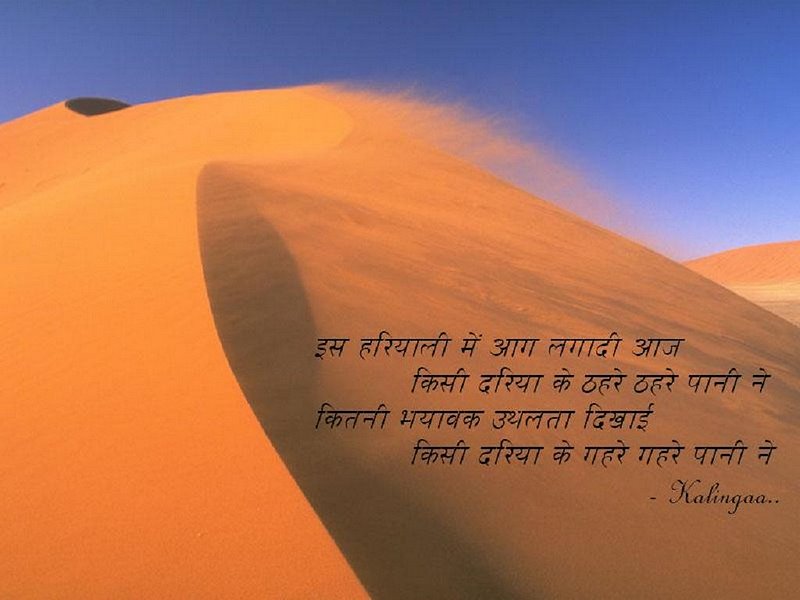
Is Hariyali Mein Aag Lagadi Aaj
Kisi Dariya Ke Thahre Thahre Paani Ne
Kitni Bhayavah Uthalta Dikhayee
Kisi Dariya Ke Gahre Gahre Paani Ne

"Esa onda irá creciendo cada día que pase, esa onda ya no parará mas."
(This wave of revolution will grow with everyday that passes, this wave will never stop. )

-- Keep the Promises fulfilled
- - Kalingaa...